Businesses and Platform Operators
The Diamond Exchange API with setup support for new or existing exchange platforms.


SPORTSBOOK DATA INFRASTRUCTURE
Itrifid is an ISO 9001:2015 certified Diamond Exchange API provider and integrator, working since 2015. We provide the Diamond Exchange API (sports, casino and odds data) for betting exchange platforms, businesses, developers and individual customers, with setup support included.
Separate the data feed from the platform actions it informs.
Confirm event, market and selection references, back/lay formats and available depth using the supplied documentation.
Agree refresh rules, stale-price handling and reconnect behaviour for the actual source. Feed availability and latency depend on the selected service.
Confirm permitted data use, optional modules and responsibilities before integration. Itrifid supplies technology; a product page does not establish operating permission.
Itrifid is an API provider and software development company founded in 2015. Explore the API product catalogue or discuss this product. Confirm included modules, usage limits and support terms in your written quotation.
Itrifid Private Limited is a Diamond Exchange API provider and integrator, working since 2015. We provide API integration services for the Diamond Exchange platform to sports and casino businesses, including live odds and market data, match information, wallet and account functions, and admin and reporting tools. Every plan includes documentation, a test playground, a free demo, setup support and 24/7 technical support, and our prices are published on this page.
The Diamond Exchange API with setup support for new or existing exchange platforms.
Launch faster with ready modules and a white label platform option.
Documentation, test playground and sample responses for client projects.
The same API, plans and support for individual buyers.
Choose the plan that fits your platform. All plans include documentation and setup support.
Compare plan scope, setup and recurring charges in the detailed pricing guide before selecting individual feeds or the complete suite.
Live sports data
Complete suite
Casino & live games
The Diamond Exchange API is a set of ready-to-use data and platform services for sports exchange and casino platforms. It connects your website or app to live market data, match information, wallet and account functions, and admin and reporting tools, so you can launch or extend a platform without building every module from scratch. Itrifid provides the API with documentation and a test playground, with setup support for businesses, startups, developers and individual customers.
When a user places a bet on your platform, the Diamond Exchange API handles the complete lifecycle — from market selection through odds delivery, bet matching, wallet management and settlement. Here is how each step works.
This reference flow explains the responsibilities to agree for your integration. Matching, wallet ownership, available markets and settlement rules depend on the approved source and selected implementation; confirm the production contract before enabling transactions.
Your platform displays available matches and markets. The user opens a match (e.g., an IPL T20 game) and selects a market type — Match Odds, Bookmaker, or a Fancy/Session market. The Diamond Exchange API delivers the available markets and current back and lay odds in real time.
Your backend sends a REST or WebSocket request to the Diamond Exchange API endpoint. The API returns current back and lay prices, available volumes at each price level, and market status (open, suspended, or closed) for the selected market.
The odds engine processes incoming market data and pushes updated back/lay prices and volume changes to your platform through WebSocket connections. Updates are delivered as they change — not on a fixed polling interval.
The user selects odds and enters a stake. Your platform sends the bet details to the API — market ID, selection, odds, stake amount, bet type (back or lay) and currency — for validation. For a back bet, maximum loss is normally the stake. For a lay bet, liability is stake multiplied by (decimal odds minus one); show that exposure before confirmation.
The API validates the bet against available market volume and the user's wallet balance. It attempts to match the back bet with a corresponding lay bet (or vice versa) at the requested odds. Unmatched bets remain open in the order book until matched or cancelled. Reserve the required funds or lay liability before accepting an order. A price change, suspension or insufficient balance must produce an explicit rejection or the agreed requote flow, rather than a silent execution at a different price.
On acceptance, the wallet reserves the required stake or lay liability; matching confirms the exposure against that reservation. The API returns a unique bet ID, matched amount, execution odds and potential profit. Unmatched amounts remain reserved according to the agreed rules and are released on cancellation. A retry must reuse its transaction reference so a timeout cannot create a second debit.
After the sporting event ends, the settlement engine identifies all open bets for that market. It determines the winning selection based on the match result and calculates the payout for each matched bet. Use the authorised result source and the market rule, including void, abandoned-event and correction scenarios. The end of play alone is not a reliable instruction to settle every market.
The API settles all matched bets, credits winnings to winning users' wallets (minus the platform commission), and publishes settlement records. The admin panel displays settlement summaries with match-level references for reconciliation. Release remaining reservations and reconcile credits, losses and configured commission against unique settlement references. Corrections should create traceable adjustment entries; never overwrite the original ledger movement without an audit trail.
Combine exchange data with live Casino API feeds where included in your scope, or review Betfair API integration for source-specific market connectivity.
Ready-to-use APIs for sportsbook, casino and iGaming platforms.
Real-time markets, odds & wallet for sportsbook platforms.
YOU'RE HERELive scores, fixtures & odds across multiple sports.
Learn more →Casino game data & live casino connection.
Learn more →Ball-by-ball cricket data, scores & odds.
Learn more →Secure deposits, withdrawals & balance management.
Learn more →Launch a complete exchange platform under your own brand, with the Diamond Exchange API, admin panel and setup support.
Multiple game providers through one connection.
Learn more →Explore the related Itrifid pages for the sports and platform data services relevant to your project.
Live scores, fixtures, scorecards and ball-by-ball data.
Live scores, fixtures, results and team and player data.
Live scores, players, matches, tournaments and statistics.
Live matches, scores, team and player analytics and league data.
Casino game data and live casino connection.
Match and player data for fantasy platforms.
Beyond standard Match Odds and Bookmaker markets, the Diamond Exchange API delivers Fancy and Session markets — the high-frequency, in-play market types that drive engagement on exchange platforms.
Match odds markets cover the event result using back and lay prices. Football commonly has home, away and draw selections; cricket, tennis and basketball frequently use two selections, but ties, draws and competition rules can change the market definition. Read the supplied runner list and settlement terms rather than hard-coding the number of outcomes. Show current status and available volume with the price so users can distinguish an indicative quote from executable liquidity.
Bookmaker markets quote prices with a designated counterparty rather than requiring the same exchange order-book flow. Margins, maximum stakes, acceptance delays and liability controls depend on the source and platform agreement; they are not universally higher or lower than exchange pricing. Keep bookmaker references separate from exchange market IDs, show explicit acceptance or rejection, and test the behaviour when a price changes while the user submits an instruction.
Cricket fancy markets may cover innings or match runs, a named over, the next wicket or individual player performance. Labels such as Lambi Runs and Khada Runs are source-specific: confirm exactly which innings, period and result condition each market means. Do not infer settlement solely from a display label. These fast-changing markets need clear suspension events, minimum and maximum exposure rules, and a reliable mapping from the fancy identifier to the approved result source.
Session markets express a proposition over a defined interval or milestone. A displayed Yes at 38 / No at 36 is only a quotation illustration: the meaning of those numbers, the applicable rate and the interval must come from the source contract. Markets suspend around relevant events and settle when their own result is final, not automatically after every over. Deliver state updates to the interface and retain the exact market definition used when the instruction was accepted.
A reference lifecycle is INACTIVE → OPEN → SUSPENDED → CLOSED → SETTLED. Actual feeds can reopen a suspended market, void a selection or issue a settlement correction, so model permitted transitions explicitly instead of treating the sequence as irreversible. Streaming state events reduce repeated polling where supported, while reconnect recovery still needs a fresh authoritative snapshot. Keep the state shown in the interface consistent with the backend rule that accepts or rejects a transaction.
Separate source connectivity from application logic. The incoming feed supplies approved market updates; your backend interprets those updates, maintains application state and delivers information to clients. Document identifiers, timestamps and market-state transitions so the boundary between systems is explicit.
For real-time odds connection, define freshness thresholds and recovery behaviour as carefully as the normal update path. Wallet records, commission rules and exposure checks need their own contracts and tests. Confirm source coverage and permissions rather than treating all market types as interchangeable.
Organise the REST API by function: available markets, current odds, bets, wallet balances and settlement records. Reference paths such as /v1/markets, /v1/odds, /v1/bets, /v1/wallet and /v1/settlement illustrate that separation; they are not published live endpoints. Use the supplied documentation for production routes, authentication headers, pagination, rate limits and supported versions. JSON responses should carry stable identifiers and structured errors so the backend can distinguish a validation problem from a retryable failure.
Persistent WebSocket connections deliver subscribed odds updates where supported by the approved feed. Track back and lay prices, available depth and source timestamps separately from the time your server received a message. A wicket, injury or weather interruption can suspend a market; a suspended market is different from a lost connection. Recover by obtaining a fresh snapshot and reconciling sequence or cursor state according to the source contract before displaying prices as current.
Exchange matching pairs compatible back and lay orders against available liquidity. An order can be fully matched, partially matched, rejected or left unmatched, depending on execution rules. Confirm price-time priority, minimum stake, cancellation behaviour and the treatment of price changes with the source. Commission configuration belongs to the agreed commercial model. A bookmaker market may use a different counterparty and acceptance process, so do not apply exchange order-book assumptions to every market.
The wallet records deposits, withdrawals, reservations, releases, losses and winnings with unique transaction IDs and timestamps. Confirm whether the platform or provider owns the authoritative balance, how supported currencies are represented and when a balance becomes spendable. Use decimal-safe amounts or documented minor units, idempotent operations and reconciliation reports. A settlement callback should be safe to retry without crediting the same winnings twice; adjustments need a linked, auditable record.
Keep API keys and secrets on the server. Agree Bearer token expiry and rotation, IP allowlisting and least-privilege roles for the selected deployment. Require TLS 1.2 or newer for API transport and reject unencrypted access. Separate sandbox and production credentials, redact secrets from logs and revoke compromised access promptly. Role-based access control should distinguish read-only support, operational changes and financial approvals rather than assigning every account the same permissions.
Monitor feed freshness, connection state, subscription counts, API usage, error rates and response times alongside wallet and settlement exceptions. An operator needs the event, market and transaction references behind a warning, not only a red status badge. Restrict user management and configuration changes by role, retain audit history and assign an owner to each alert. Confirm dashboard metrics, retention and 24/7 escalation responsibilities during handover so the interface reflects the agreed support scope.

FROM FEED TO PLATFORM
A dependable connection needs clear boundaries between the source feed, your backend and the operator interface. Plan those connections before implementation.
The engineering discussion covers feed handling and the operational workflows around it. Use the following checklist to agree scope with Itrifid: what the source provides, what the backend must implement, and how the result will be tested. It is a planning framework, not a claim that every feature is included by default.
Map event IDs, market IDs, price formats and source timestamps before connecting a feed. Define when an update is stale and how the application handles a suspended market. Available sports and update behaviour depend on the approved upstream access.
Separate incoming odds from order acceptance and matching logic. Agree the rules for duplicate requests, price changes, suspended markets and rejected actions. Test these transitions before enabling an automated workflow.
Use unique transaction references and explicit state transitions for credits, debits and adjustments. Plan reconciliation between platform records and the source system; retries must not create duplicate balance changes.
Define exposure limits, alert thresholds and review permissions for the intended operating model. Record why a rule triggered and how an operator resolved it. Monitoring assists review; it does not guarantee fraud prevention.
Separate account management, reporting and operational actions by role. Specify which changes require approval, and retain an audit trail for changes to limits, commission settings and market access.
Estimate concurrent connections and peak update volume. Select queueing, caching and storage behaviour around those estimates, then test under representative load. Capacity and latency should be measured in the intended hosting environment.

MARKET OPERATIONS
Define how the operator interface communicates fresh, delayed and suspended market states.
Available work includes new platform development, adapters for existing systems, market-specific modules and agreed maintenance. Confirm interfaces, coverage and exclusions in the scope. Source documentation takes precedence over a general service description.
For a new platform, define service boundaries, account workflows and reporting requirements before implementation. Decide which functions belong to the data source and which must be built in your backend.
Review the current web or mobile application, credentials and API contracts. Map identifiers and error responses explicitly so a source change does not silently alter application behaviour.
Cricket, football, tennis, casino, fancy and session workflows need their own coverage and state-mapping review. A listed module is not a guarantee that every market or provider is included in the subscription.
Agree responsibility for feed changes, monitoring, incident triage and version upgrades. Document escalation contacts and support scope before release; response commitments belong in the service agreement.
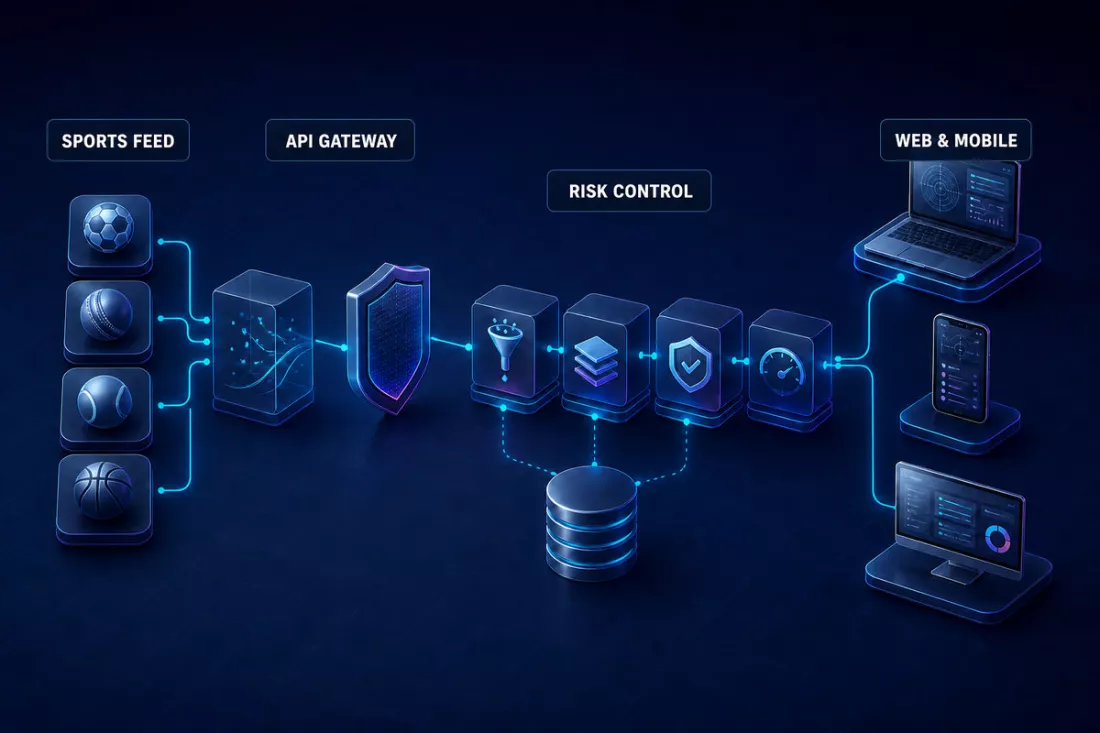
SOURCE BOUNDARIES
Give each module a clear contract so a source change does not silently alter downstream behaviour.
Plan the feed contract, performance checks and failure handling before connecting your production platform.
Low-latency delivery is a design objective, not a published benchmark. Confirm WebSocket availability and the transport supported by your approved feed before implementation.
Measure source-to-client delay under representative load. Agree reconnect behaviour, stale-message thresholds and monitoring with the technical team.
No verified latency or uptime figure is published here. Any performance commitment must be defined in the agreed service scope.
{
  "event_id": "EV-98234",
  "sport": "Cricket",
  "match": "IND vs AUS",
  "market": "Match Winner",
  "odds": { "back": 1.95, "lay": 1.97 },
  "timestamp": "2026-09-09T08:30:00Z"
}
Illustrative — not a live endpoint. Field names and structure may differ in production.
Sample values only; this is not current match data or a guaranteed response schema. Confirm field names, identifiers, odds format and timestamp semantics against the supplied connection documentation.
POST /v1/auth/token · Content-Type: application/json
Request
{
  "api_key": "your_api_key_here",
  "api_secret": "your_api_secret_here",
  "grant_type": "client_credentials"
}
Response
{
  "access_token": "eyJhbGciOiJSUzI1NiIs...",
  "token_type": "Bearer",
  "expires_in": 3600,
  "scope": "markets:read odds:read bets:write wallet:read"
}
Illustrative — not a live endpoint. Field names and structure may differ in production.
WSS wss://api.example.com/v1/odds/stream
Subscribe message
{
  "action": "subscribe",
  "market_ids": [
    "match_odds_ipl_m42",
    "bookmaker_ipl_m42"
  ],
  "token": "Bearer eyJhbGciOi..."
}
Odds update payload
{
  "event": "odds_update",
  "market_id": "match_odds_ipl_m42",
  "runners": [
    {
      "selection": "Mumbai Indians",
      "back": [
        {
          "price": 1.65,
          "size": 50000
        },
        {
          "price": 1.64,
          "size": 25000
        }
      ],
      "lay": [
        {
          "price": 1.67,
          "size": 30000
        },
        {
          "price": 1.68,
          "size": 15000
        }
      ]
    },
    {
      "selection": "Chennai Super Kings",
      "back": [
        {
          "price": 2.4,
          "size": 35000
        }
      ],
      "lay": [
        {
          "price": 2.45,
          "size": 20000
        }
      ]
    }
  ],
  "status": "OPEN",
  "timestamp": "2026-04-15T20:14:02.341Z"
}
Illustrative — not a live endpoint. Field names and structure may differ in production.
POST /v1/bets/place · Authorization: Bearer <token>
Request
{
  "market_id": "match_odds_ipl_m42",
  "selection": "Mumbai Indians",
  "bet_type": "BACK",
  "odds": 1.65,
  "stake": 10000,
  "currency": "INR"
}
Response
{
  "bet_id": "BET-2026-0415-78923",
  "status": "MATCHED",
  "matched_amount": 10000,
  "unmatched_amount": 0,
  "average_odds": 1.65,
  "potential_profit": 6500,
  "wallet_balance": 140000,
  "timestamp": "2026-04-15T20:14:05.112Z"
}
Illustrative — not a live endpoint. Field names and structure may differ in production.
GET /v1/settlement/STL-2026-0415-42
Response
{
  "settlement_id": "STL-2026-0415-42",
  "match_id": "ipl_2026_m42",
  "market_id": "match_odds_ipl_m42",
  "market_type": "MATCH_ODDS",
  "result": "Mumbai Indians",
  "bets_settled": 847,
  "total_matched_volume": 12500000,
  "commission_collected": 62500,
  "settlement_time": "2026-04-15T23:45:12Z",
  "status": "COMPLETED"
}
Illustrative — not a live endpoint. Field names and structure may differ in production.
The examples describe separate interface concepts, not a runnable production specification. Do not send credentials or customer data to api.example.com. Obtain the actual base URL, token contract, idempotency mechanism, market identifiers and error catalogue from the supplied API documentation. Keep these examples in a sandbox fixture and replace the adapter only after confirming the live contract.
A standard Diamond Exchange API integration takes 2 to 4 weeks depending on your platform’s complexity, team size and scope. Here is the typical phase breakdown.
| Phase | Duration | Deliverables |
|---|---|---|
| Discovery and Planning | 2–3 days | Requirements document, API access scope |
| Sandbox Setup and Testing | 3–5 days | Sandbox credentials, test data, endpoint mapping |
| Frontend Integration | 5–10 days | Market display, odds rendering, bet placement UI |
| Wallet and Settlement Setup | 3–5 days | Wallet connection, deposit/withdrawal, settlement flow |
| QA and Security Testing | 3–5 days | End-to-end testing, load testing, security audit |
| Production Launch | 1–2 days | Production credentials, go-live monitoring |
| Total | 2–4 weeks | Depends on platform complexity |
The phase estimates overlap: frontend work, wallet development and testing can run in parallel after contracts are agreed. Adding every row as consecutive working days would produce a longer schedule. Treat the total as a planning range, with delivery milestones confirmed after discovery.
Timeline depends on platform complexity, team size and scope of integration. Simple score-only integrations can be faster. Follow the step-by-step integration guide to prepare access, acceptance tests and release responsibilities.
Begin with a review of the current system and approved source interfaces. Record the expected event flow, failure cases and account-state transitions. An implementation estimate should follow that review, with dependencies and acceptance criteria documented for each milestone.
Before release, test reconnects, duplicate messages, permission failures and reconciliation. Agree how a failed deployment will be rolled back and who owns incident triage. Post-launch monitoring and maintenance are subject to the support arrangement; they are not an unlimited service commitment.

RELEASE READINESS
Validate wallet consistency during deployment with opening balances, reserved funds, matched exposure and settlement adjustments. Replay timed-out requests and interrupted callbacks against the same transaction references. Compare the platform ledger with provider records before enabling real balances, and document the release checkpoint that stops rollout when the two systems disagree.
Scale launch infrastructure around measured concurrent connections, market subscriptions and peak update rates. Warm caches, bound queues and test reconnect storms before opening access broadly. Increase traffic in stages while watching queue age, database contention and response times; retain a rollback threshold so additional capacity is introduced without losing transaction consistency.
Structured market workflows suit exchange operators, sportsbook teams adding a second feed, agencies connecting an existing platform and developers building a focused market interface. Each needs explicit market states, transaction ownership and settlement references. Start with the actual operating model and authorised data coverage so the implementation serves a defined audience rather than an assumed universal feed.
Automated checks can flag stale odds, unexpected price jumps, repeated transaction IDs, unusual rejection rates and exposure-limit breaches. Route alerts to an accountable operator with the market reference and supporting timestamps. Tune thresholds against realistic traffic, distinguish a connection fault from suspicious activity, and keep a documented review process; anomaly detection does not guarantee fraud prevention.

ACCESS & MONITORING
A monitoring dashboard brings feed freshness, connection health, error rates and settlement exceptions into one operational view. Restrict sensitive actions by role, record permission changes and separate investigation access from approval authority. Assign alert ownership and an escalation path so the team can investigate a delayed update or wallet mismatch without granting every user unrestricted financial access.
These illustrative scopes explain how work can be divided into testable components. They are not customer endorsements or evidence of completed deployments. Each real project requires its own coverage, technical and commercial review.
An example scope connects cricket market updates to account records, exposure checks and reconciliation reports. Validate market suspension, delayed updates and settlement corrections with agreed test cases.
An existing platform may need a new feed adapter, clearer permissions and better event logging. Document old and new behaviour and use a staged rollout to reduce release risk.
For multiple sources, agree identifier mapping, supported markets and error semantics for each adapter. These are planning examples, not named client case studies or verified delivery outcomes.
Read the complete guide to Diamond Exchange API features, setup and cost factors.
Read the practical guide to cricket markets, data and settlement workflows.
Review the points to check before selecting an API provider and planning your setup.
Share your architecture, required markets and the next release objective. A technical discussion can identify interface dependencies and the information needed for a scoped proposal. Keep production credentials out of public messages.
Our products and APIs are built and supported in-house by the Itrifid Pvt. Ltd. technical team in Ranchi, India - handling development, integration and 24/7 support since 2015.
Itrifid Pvt. Ltd. - ISO 9001:2015 certified, serving businesses since 2015.
Itrifid delivers Diamond Exchange API remotely for businesses across North America, the UK & Europe, the Middle East, Asia-Pacific, Africa and Latin America, with 24/7 support from our team in India.
Itrifid provides the Diamond Exchange API as technology infrastructure. We do not operate betting exchanges, accept wagers, or hold gambling licences. Platform operators are responsible for regulatory compliance in their jurisdiction.
The API includes built-in features that support compliance and security workflows. Confirm the following controls, identity-provider connections and retention requirements in the selected deployment scope:
This section provides general technical information and is not legal advice. Consult with a licensed legal professional for jurisdiction-specific regulatory requirements.
Itrifid provides the Diamond Exchange API to platform operators in Dubai and the UAE, Bangladesh, Malaysia, Turkey, the United Kingdom, India and 30+ other countries. Integration support, documentation and 24/7 technical assistance are available regardless of your location.
A Diamond Exchange API provider supplies the API and live data feeds that sports exchange, betting exchange and casino platforms run on: real-time odds, back/lay prices, sports markets, match data, casino games, and wallet and admin functions. Itrifid has provided the Diamond Exchange API since 2015, with documentation, a free demo and 24/7 technical support.
Share the current architecture, source documentation, required markets and expected usage. Do not send production credentials through a public contact form. Agree a secure access process separately.
Compatibility depends on the current codebase and available interfaces. A review identifies adapter work, data mapping and changes needed before an implementation estimate is agreed.
Confirm coverage with the approved source. Cricket, football, tennis, casino, fancy and session workflows may have different access requirements and are not automatically included as a single feed.
Agree heartbeat and reconnect behaviour, stale-data thresholds and sequence handling. Test recovery after a connection loss and define when the application should stop using old prices.
Define unique references, accepted states and reconciliation reports. Test retries, duplicate events and corrections against the agreed accounting rules before release.
No. Alerts and exposure controls support operational review. Their effectiveness depends on the rules, data quality and the team's response process.
Role definitions and permitted actions can be part of the agreed development scope. Document approval requirements and audit records for sensitive account or limit changes.
Source access, interface documentation, the existing codebase and acceptance testing affect the schedule. Confirm milestones after technical discovery rather than assuming a fixed launch date.
Confirm source rights, operating requirements, hosting allocation and maintenance responsibilities in the quotation. Serving a region technically does not establish permission to operate there.
Anyone who needs it. Itrifid provides the Diamond Exchange API to businesses, startups, developers and individual customers, with affordable, transparent pricing and setup support.
The Diamond Exchange API is a set of ready-to-use data and platform services for sports exchange and casino platforms. It connects your website or app to live market data, match information, wallet and account functions, and admin and reporting tools.
Yes. Itrifid reviews your platform and scope first and then sets up the modules you need.
Send an enquiry or message us on WhatsApp. After a short call about your requirements you get documentation, test access and a setup plan.
Itrifid is a trusted Diamond Exchange API provider for businesses, startups, developers and individual customers, with clear documentation and support.
Page last updated:
GST, setup and hosting included. Confirm deliverables, capacity, hosting duration and support in your written quotation.